Metal reviews for old school metal bands like thrash metal, death metal, black metal and more genres. All opinions and contribubtions are welcome,
Metal reviews albums for only metalheads.
The true warriors in the world is the people who never lost your minds.
Hvis lyset tar oss (Norwegian for If the Light Takes Us) is the third studio album by Norwegian black metal solo project Burzum. It was recorded in September 1992, but was not released until April 1994, whereupon it was released through Misanthropy Records and Vikernes' own record label, Cymophane Productions.[1] The album is considered a classic in the black metal scene.[5]
All tracks written by Count Grishnackh.
No.TitleLength
1."Det som en gang var" ("What Once Was")14:21
2."Hvis lyset tar oss" ("If the Light Takes Us")8:04
3."Inn i slottet fra droemmen" ("Into the Castle from the Dream")7:51
Varg Vikernes recorded the first four Burzum albums between January 1992 and March 1993 at the Grieg Hall in Bergen. However, the releases were spread out, with many months between the recording and the release of each album. During this time, Vikernes became a part of the early Norwegian black metal scene and befriended Mayhem guitarist Euronymous. The two developed a feud that culminated in Vikernes stabbing Euronymous to death in his apartment building in Oslo in August 1993. He was arrested a few days later and, in May 1994, was sentenced to 21 years (the maximum sentence in Norway) in prison for murder and several church arsons.
The album cover features a drawing by 19th century artist Theodor Kittelsen named Fattigmannen (The Pauper). Vikernes dedicated the album to Fenriz of fellow Norwegian black metal band Darkthrone and "Demonas",[6] possibly referring to Demonaz from Norwegian black metal band Immortal. Promotional copies sent to fanzines included the song "Et hvitt lys over skogen" (Norwegian for "A White Light Over the Forest") instead of "Tomhet". "Et hvitt lys over skogen" later appeared on the 1998 compilation album Presumed Guilty.
According to Vikernes, Hvis lyset tar oss is a concept album, about:
"[...] what once was, before the light took us and we rode into the castle of the dream. Into emptiness. It's something like: beware the Christian light, it will take you away into degeneracy and nothingness. What others call light I call darkness. Seek the darkness and hell and you will find nothing but evolution."
It’s actually surprising to me how one of the most praised and popularly acclaimed releases by the thoughtless masses supposedly or allegedly belonging to the black metal genre is actually one of the worst albums in the genre, and doesn’t actually represent the genre whatsoever or make a valid presentation of its musical attributes in any way at all, but rather takes everything bad and of the lowest quality possible about it and condenses it in an almost parodic sea of thoughtless deviation and pointless randomization of looped passages of weak instrumentation and atrocious vocal sections of straight-up bad delivery. Can’t forget about the worthless ambient passages that sound like a knock-off of more well thought-out, more styled-up, more elaborate, and all around higher quality ambient works.
If there’s one single positive thing I can say about this release is the fact that it’ll definitely make a lot of people who initially might have thought of black metal as an extreme genre stay the fuck away from it after listening to “Hvis lyset tar oss” for fifteen minutes and beginning to fall asleep on the spot. At the same time though, quite ironically, this is actually one of the full-lengths that has brought black metal to the attention of the most random of idiots who actually don’t know a single thing about black metal, yet feel like they’re some kind of experts on the genre after having listened to this dishonest, frail piece of work that deconstructs everything of any quality that the originators of the genre built in favor of pointless faux-image, atmospheric drivel, and a frail, sad-sounding frontman that no one would want to listen to for too long unless being under the peril of contracting his apparent deadly disease that renders his emotions vain and his expression void of any kind of strength or attitude were an attractive thought to them. So perhaps driving away those wanting or looking for extremity in the genre isn't even a good thing.
The music on this whole album is completely forgettable and nothing to write home about. The riffs are paper thin, there’s no real consistency to the melodies at hand, and the risk of them ever getting stuck in your head is minimal, as much as they’re repeated time and time again needlessly throughout the endless minutes of duration of the only four tracks that make the grand total of 44 minutes and 28 seconds of running time. Both the first and the last track are over 14 minutes long for no reason at all. The musical ideas presented through each one of the tracks aren’t necessarily all that bad per se, but they become absolutely unbearable when they’re repeated and capitalized on time after time, after time, after time, after time, etc, ad infinitum. The endless droning is obviously supposed to be intended as an extra added atmospheric quality to the music, but this is not atmospheric black metal really, since it doesn’t even properly reach that level, but instead it stays in a weird interval between the more solid tonalities or sounds and the weaker or more distorted tones of a proper atmospheric release, never daring or never risking too much, probably due to the lack of solid ideas or of confidence of the songwriter in his own skills.
When one creates a masterpiece, it doesn't mean it will be seen by everyone as such, but it will be realised by anyone that listens to it as something different, far from everything the artist has already done. This is clearly the case of Filosofem, since the feeling passed by this particular album is something elsewhere still unfelt. Burzum release this album January 1st, 1996 across the Misanthrophy Records but this double vinyl 12" are reissue by the same label.
While Varg Vikernes would, in his previous releases, try to the utmost to provoke darkness and fear with very heavy songs, Filosofem would have a rather enlightening and astonishing sound made over minimalism, living up to the album title, "Filosofem", a Norwegian word meaning "philosopheme", a succinct philosophic argument, emphasising Burzum's philosophic style. This specific album is about the duality between the Sun and the Moon, light and darkness, day and night, illustrated by the wonderful Nordic mythology, that sees the Sun (the goddess Sol) and the Moon (the god Mani) as brother and sister.
The track list is:
Side A:
1. Burzum
2.Jesu død
3.Beholding the Daughters of the Firmament
Side B:
4.Decrepitude I
5.Rundtgåing av den transcendentale egenhetens støtte (Instrumental)
6.Decrepitude II
As soon as you have the album on your hands and you see such a cold and desolate cover, you can start having a feeling of what you will be listening to. This impression is strengthened after you open it and see the amazing art, both on the CD and on the inside. If you get the album phisically, I highly recommend you to open the booklet, take a look at the amazing art inside, beholding it while you listen to the album. If you understand Norwegian (or have spare time enough to translate it), you should take a look at the texts as well, and you'll understand more easily the concepts behind the music.
The guitars overall are destructive, they interact in some kind of organised chaos, since the purposely low-budget effects used made them at the same time chaotically distorted and clear, while previous guitars in Burzum would be more "natural", as in with less effects, however, rawer, hence not as clear as in Filosofem. Another instrumental point that was sharply defected in this album was the presence of keyboards and synthesisers. While these had little to no importance in the previous albums, they would give a last touch in the high end of the guitar sounds. The songs where this characteristic goes stronger are "Burzum" and "Rundtgåing Av Den Transcendentale Egenhetens Støtte", both with keyboards getting contrastingly mixed with the rhythm guitars, that play basically the same melody.
However, the accompanying section, formed by the drums and the bass, seems to be much weaker in this album, for a good reason though, since this album had a much greater focus on the melody. The bass is barely heard overall while the drums play an entrancing rhythm. The result of such a strong melody with such a simple accompaniment is the trance caused by the captivation of the song by the listener, the great Filosofem-feeling.
In the songs Burzum (the oldest one ever recorded to the project but previously unreleased), Jesu Død and Beholding the Daughters of the Firmament, to cause such a feeling, Varg would use some heavy distortion and many chaotic sound effects on beautiful and interesting melodies led by clear guitars and keyboards. This contrast involves the listener in such a way that it's impossible not to feel mesmerised by their result. I call attention for the self-titled song. Since "Burzum" is, in the Lord of the Rings series, a Black Speech word for the Mordor evil and the lyrics quite resemble the concept on the books, our first thought is that it's the sole meaning of this song. However, we can see Varg creating a parallel. Here, the night that falls would be the Dark Ages, while the darkness would be the horror the Catholic Church installed, or maybe even the "darkness" Varg sees religion to causes in a religious mind.
In the later recorded songs "Jesu Død" and "Beholding the Daughters of the Firmament", Varg creates another kind of atmosphere, making a much heavier and more serious sound, without stopping from being thought inducing as the first track though. Both songs use ice cold melodies all along the structure. Jesu Død is played with a destructive riff, with lyrics that contrast the sacred and the unholy antithetically, at the same time drawing a parallel to Nietzsche's famous sentence "God is dead", while the song's title means "Jesus's death". That could be because of the criticism of direction and rationalism used by both Varg and Nietzsche. "Beholding the Daughters of Firmament", though, are the thoughts of a dying man beholding the duality between the night and the sun, the main concept of the album (as we can see on the chart).
Meanwhile, the long instrumental tracks "Decrepitude II" and "Rundtgåing Av Den Transcendentale Egenhetens Støtte" are around the minimalist essence of the album, are both well written and, despite being big, are not tiring at all. Decrepitude II has a strong structure and is focused basically on the guitar, letting one just trip on their distorted raucously played power chords. Its falling structure makes it the perfect closing song for such an album.
Summarising my text, it's a simply amazing thing to see how, as in everything ever made through Burzum, everything fits in this album. Each note, each centimeter of art, each word of the texts. That's the best example of how a genius Varg Vikernes is. Both his big though recent fame and his polemic acts and declarations may have outshined his supreme talent, but there's no other word that could describe him but genius. Hail Varg Vikernes!!! Hail Burzum!!!
Corrían los finales de la década de los años ochentas y principios de la década de los 90´s en el páis de Noruega surgía un movimiento musical basado en las obras de Venom, Bathory, Slayer, Sodom, Mercyful Fate, Celtic Frost, Hellhammer entre otras agrupaciones del movimiento underground de los años 80´s que se consideraba como la “primera oleada de Black metal”, en ese país escandinavo surgía la necesidad musical de llevar un sonido extremo basado en esos estilos de las bandas antes mencionadas, así surgía una “segunda oleada de Black Metal”.
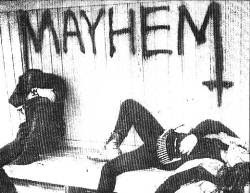
Graffitti by Euronymous in Helvete shop
Todos los jóvenes que se conocían entre sí acudían a una tienda de venta de discos nuevos así como de segunda mano ubicada en la ciudad de Oslo, Noruega propiedad del músico Øystein Aarseth (luego conocido como Euronymous en homenaje a una criatura legendaria de la mitología griega, la cual es identificada en unas ocasiones como Hades y en otras como un servidor de Hecate). Quien en su inquietud por demostrar sus habilidades musicales empezaba a crear maquetas de diversas piezas que les ponía a los miembros asistentes de su tienda de discos llamada Helvete que significa “Infierno” en el lenguaje noruego(estuvo abierta entre 1991 y 1993), ésta tienda se especializaba en Metal Extremo que redituó muy bien al joven dueño de la misma. Así decide crear su propio sello discográfico y poner su estudio de grabación en el sótano de su casa para producir a bandas locales que empezaban a surgir en esos años. A su sello le puso “Deathlike Silence Productions” en honor a una pieza de la banda alemana Sodom en 1990. En ese lugar vivieron durante algún tiempo miembros de varias bandas durante algún tiempo como Bård “Faust” Eithun trabajó y vivió en Helvete, así como Samoth integrantes de la banda Emperor, este último durante una corta temporada.
Algunas bandas que empezaron a surgir bandas conocidas como Mayhem, Burzum, Emperor, Darkthrone, Immortal, Enslaved, Thorns entre otras. Los integrantes de esas bandas empezaron a convivir constantemente entre ellos y a ser conocidos bajo el título de “Inner Circle”(el círculo cerrado) que algunos rechazarían años después en entrevistas. Para empezar varios de ellos empezaron a tener coincidencias o bien a tener cierto tipo de ideología encabezado por Euronymous como fueron las siguientes:
1.- Ideales de la era vikinga: la exaltación de la fuerza, el guerrero como hombre ideal, la guerra como fin en sí mismo, la violencia vista como virtud son ideales vikingos que esta gente creyó y que explican la gran cantidad de delitos que hicieron famoso el género musical.
2.- Ideal histórico-cultural: El movimiento black metal noruego consideró la remota época vikinga como ideal, y el final de la cultura vikinga y la consiguiente romanización y cristianización de Noruega como una invasión extranjera que se esforzó en destruir la auténtica cultura noruega y sustituirla por costumbres ajenas e inferiores. Los noruegos actuales, por tanto, debían regresar a su cultura original, rechazando el estilo de vida moderno, y continuando la guerra de vikingos contra cristianos.
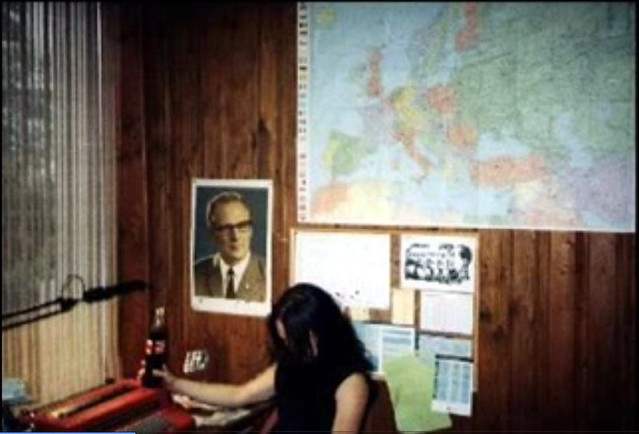
3.- Ideal religioso: la antigua religión politeísta nórdica era vista como la propia y natural de Noruega, una religión superior al estar basada en los fenómenos astronómicos y naturales (movimiento de los planetas, ciclo lunar, el ciclo de las estaciones del año, etc.) que fue destruida y sustituida por el cristianismo como parte de la invasión cultural. Por tanto, como símbolo del retorno a la época dorada vikinga, como noruegos sentían el deber de rechazar el cristianismo y expulsar esa religión de su país. En este punto algunos consideraban que se debía volver a la remota religión politeísta vikinga. Muchos, sin embargo, únicamente deseaban la erradicación del cristianismo, y como símbolo de ello se autoproclamaron satanistas, aunque no tenían ningún culto organizado de adoración, y no tenían tampoco relación alguna con la Iglesia de Satán de Anton LaVey. Se puede añadir que no tenían ideales políticos unitarios; así Euronymous de Mayhem era comunista-estalinista mientras que Varg Vikernes de Burzum a mediados de los años 1990 se autodenominó nacionalsocialista, hoy en día Vikernes dejo de referirse a sí mismo como nacionalsocialista y ha identificado su ideología con el odinismo.
En síntesis que cada uno tenía una propia idea de lo que en su opinión, perjudicaba a la cultura noruega y como debían rescatar sus tradiciones y costumbres ante el embate de las creencias y la filosofía occidental en su propio país. En lo que coincidieron es en poseer un fanatismo extremo ante sus propios ideales.
Varg Vikernes & Euronymous: Norwegian Inner Circle
La fundación de MAYHEM
El joven Aarseth, quien según aquellos que lo conocían, era un ser ególatra y ambicioso, en 1984 fundaría su propia banda Mayhem, de la cual él mismo sería vocalista y guitarrista, su inspiración viene del tema “Mayhem With Mercy” de Venom. De hecho, él declaró que la máxima influencia musical de Mayhem era Venom(para aquellos metalheads que no les gusta la banda inglesa debe ser un trauma). Para este proyecto en sus inicios reclutó al bajista Jørn Stubberud (alias Necrobutcher), y al batería Kjetil Manheim (alias Manheim). Después, Aarseth se concentraría exclusivamente en la guitarra y reclutaría al vocalista Eirik Nordheim (alias Messiah). Ellos grabarían las maquetas “Voices of a Tortured Skull” (1986) y poco después “Pure Fucking Armaggedon”, ambas con una producción desastrosa, como otras bandas de black metal, llevaban la cara maquillada en blanco y negro. Hoy por hoy, pese a la baja calidad del sonido, esos demos son consideradas auténticas piezas de culto.
Eirik Nordheim (alias Messiah), abandonaría la banda debido a los conflictos que tenía con el líder del grupo Euronymous debido a que el primero tenía creencias cristianas, siendo sustituido por un talentoso joven llamado Sven Erik Kristiansen (alias Maniac), un personaje con bastantes problemas mentales. Esta formación grabará en 1987 su primer LP, el brutalísimo “Deathcrush”, que obtuvo un discreto éxito. Aun así, la crítica dijo del disco: “En este disco se encuentran los riffs más brutales de la historia, únicamente escuchables por almas perdidas”. El caso es que tras este trabajo, Maniac y Manheim abandonan Mayhem, siendo sustituidos por el gran vocalista sueco Per Yngve Ohlin (alias Dead), ex vocalista del grupo Morbid, y el joven batería Jan Axel Blomberg (alias Hellhammer). Esta formación lanzaría, el álbum en directo Live in Leipzig, publicado en 1990. El célebre periodista noruego Metalion recordaba: “El primer concierto de Mayhem que vi fue en Jesseim, en 1989, pero en 1990 organicé un show en Sarpsborg, donde yo vivía. Era bestial. Euronymous quería un espectáculo muy extremo, con mucha sangre y montones de maquillaje. Recuerdo que Dead se rajó la camiseta con una botella de cristal rota. La música era mortífera…” escribió dándonos una idea de como deberion haber sido aquellos conciertos undergrounds en los primeros años de la década de los 90´s en Noruega.
Los actos extremos del Inner Circle y su abrupto final.
Esta organización recibió otros nombres por parte de la prensa noruega aparte de Inner Circle; nombres como Black Metal Mafia, Black Militia, Black Metal Circle, Satanic Terrorists y estaba formada por aquellos jóvenes que rondaban por Helvete, así como miembros de bandas de black metal como Emperor, Darkthrone, Thorns entre otros. Cómo recuerda el batería de Emperor, Bard “Faust” Eithun: “Para mí aquellos tiempos fueron muy especiales. La tienda era el punto de encuentro de mucha gente. Nuestro sentimiento alrededor de la tienda de Euronymous era que todos estábamos juntos en la lucha contra todas las religiones organizadas que había en Noruega. El plan era hacer una organización que basara sus actos en actividades ilegales. Teníamos un colega que vivía cerca y que nos podía conseguir las armas suficientes…”
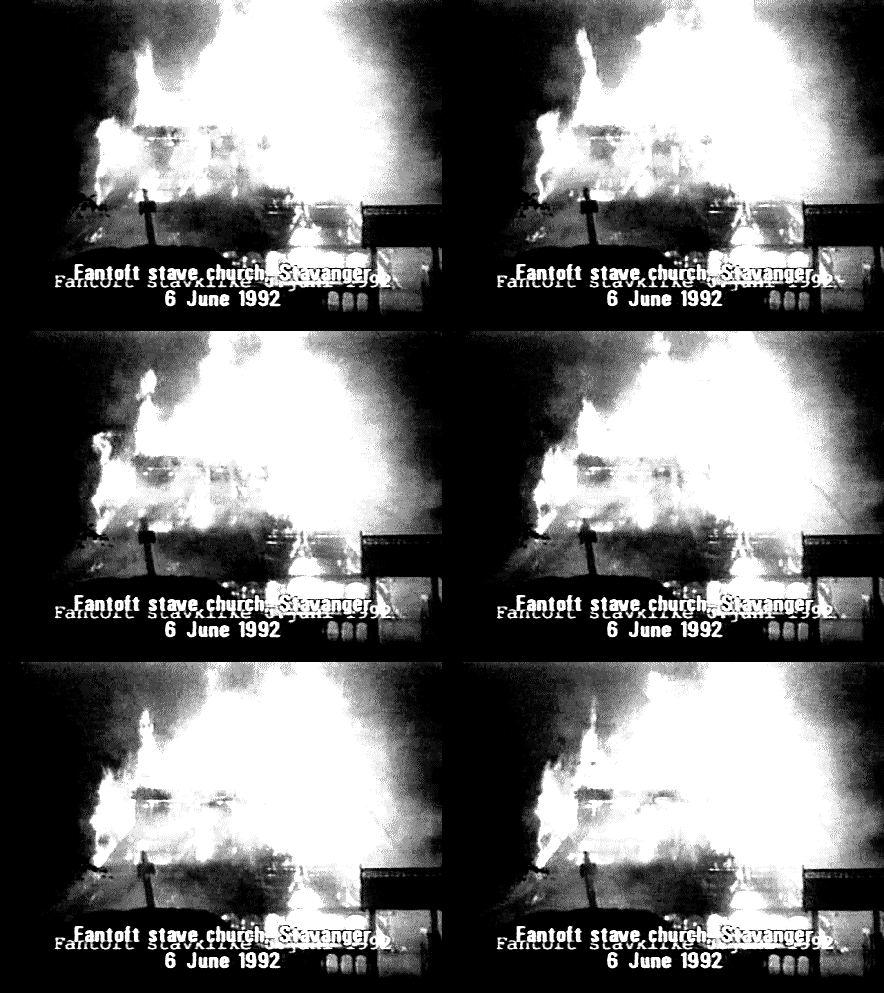
Entre los años 1992 y 1998 fueron quemadas alrededor de 52 iglesias, 15,000 tumbas fueron profandas en cementerios por diversas partes, así como diversas obras arquitectónicas fueron pintadas con dibujos relacionados al satanismo(algunos de esos fueron fotografiados y se pueden ver en algunos discos). Entre las estructuras religiosas más importantes que fueron incendiadasdurante esos años fue la iglesia medieval de Fantoft, cerca de Bergen, quemada el 6 de junio de 1992, fue sospechoso el integrante de Burzum Varg Vikernes pero no se encontraron pruebas, pero si lo hallarían culpable de los incendios provocados a las capillas Holmenkollen y Skjold, una fotografía de lo que quedo de la estructura Fantoft Stave se convirtió en la portada de su álbum Aske.
Los proyectos e ideales del Inner Circle pudieron ser más extremos y llevados a otros lugares, por ejemplo en Suecia se llevó a cabo el incendio de una iglesia que se atribuyó a los miembros de la banda Abruptum, pero los cargos en contra de los integrantes fueron retirados por falta de pruebas. El 10 de agosto de 1993 Øystein Aarseth fue acuchillado por Varg Vikernes (quien se hacía llamar "Count Grishnackh"), artífice de Burzum. Según el informe oficial, fue acuchillado 23 veces: 2 veces en la cabeza, 5 veces en el cuello y 16 veces en la espalda. De todas formas Vikernes niega esto, diciendo que Aarseth se cayó encima de vidrios rotos mientras corría, lo que puede explicar la cantidad considerable de heridas. Vikernes aclara que lo que hizo parcialmente en defensa propia y bajo una supuesta amenaza de muerte
Para rematar todos estos actos la banda Mayhem planeaba coincidir con la publicación de su primer álbum de estudio “De Mysteriis Dom Sathanas”, Vikernes(quien ocupo el puesto de bajista en éste trabajo) y Aarseth habían conspirado para hacer estallar la Catedral de Nidaros, de Noruega que aparece como portada del álbum. Pero el asesinato de Aarseth por Vikernes en agosto de 1993 puso fin a este plan, y a la vez retrasó el lanzamiento del álbum. Los músicos Samoth, Faust, y Jørn Inge Tunsberg también fueron condenados por incendios provocados a iglesias así como de asesinato como en el caso de Faust. Vikernes igual fue condenado a la pena máxima por asesinato en Noruega(fue liberado bajo reservas en el año 2009). Euronymous fue reconocido como uno de los guitarristas más creativos al definir el sonido de la segunda oleada de Black Metal. Otros músicos fueron arrestados y liberados por falta de pruebas, se sembró una pequeña época oscura en ese país escandinavo que finalizó el mismo año de la muerte de Aarseth.
Como conclusión tenemos que ante los ideales que poseían los diversos miembros de quienes fueron nombrados como “Inner Circle” resultó una guerra de egos por el liderazgo y la imposición de la voluntad individual por encima del conjunto. Que terminó en el asesinato entre algunos de sus miembros debido a su incapacidad por resolver asuntos que rayaban en lo extremista y la política hasta cierto punto racista. Como pudimos leer fueron víctimas de las diversas circunstancias presentadas debido a sus acciones rebasaron el sentido musical de su estilo y letras sin lugar a dudas. Plasmaron sus letras en la vida real al caer en actos catalogados como vandalismo y terrorismo que pusieron en jaque no sólo a la sociedad de su país sino entre ellos mismos.
Links de algunos documentales acerca del Inner Circle noruego.